
Almost every medical office in the world has the same exact protocol when a patient walks in. The first two things a nurse does is measure a patient’s height and weight; with these two simple numbers, a third number is generated, and that number is the person’s Body Mass Index, or BMI. This is the most common measure of weight used in the world’s health assessments, and is also one of the most controversial.
To some, BMI is a very important screening tool that estimates the chance of getting a chronic disease. To others, it is an old and inaccurate measure that does not consider the complex nature of the human body. So, what is the truth about BMI? This will be a 1,500 word document that will examine the history, math, clinical usefulness, and the huge drawbacks of this metric. This will help you to put BMI within a context of a bigger picture that includes an individual’s overall health, activity levels, and the presence of metabolic health issues.
At its most basic level, BMI is a mathematical calculation. A Belgian mathematician named Adolphe Quetelet, who attempted to define the “average man,” developed a formula for calculating height to weight ratio in the mid-19th century. Quetelet’s formula was never intended to be a measurement for individual health; however, it is the most widely used health measurement in the world today.
In order to understand your results, first you must understand how your results where calculated. Responses stay the same whether you used an online body mass index calculator or did the calculations yourself.
The Formula for Measuring Metric BMI:
If your weight is recorded in kilograms and your height is measured in metres, then your formula would look like:
Metric Formula: BMI (Body Mass Index) = Weight (kg) / Height (m)²
The Formula for Measuring Imperial BMI:
If your weight is measured in pounds and your height is measured in inches, then your formula would look like:
BMI (Body Mass Index) = 703 * Weight (lb) / Height (in)² - Note: this is called a conversion factor.
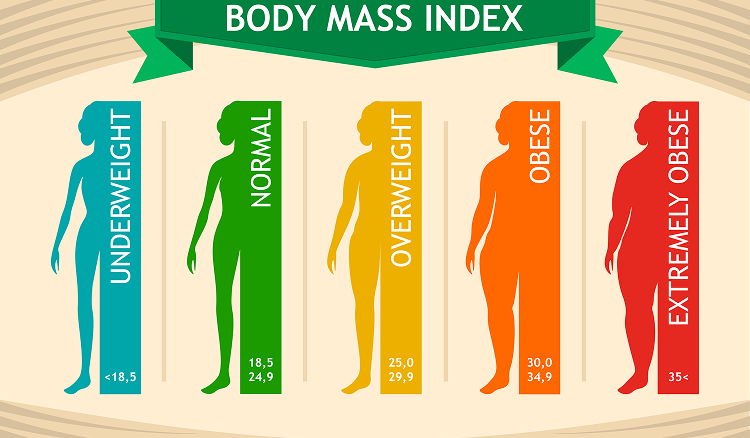
The BMI is then put into a category set by the World Health Organization (WHO) and the National Heart, Lung, and Blood Institute.
| BMI Range | Category |
|---|---|
| Below 18.5 | Underweight |
| 18.5 – 24.9 | Healthy weight |
| 25.0 – 29.9 | Overweight |
| 30.0 and Above | Obese |
If BMI is “simple math”, then why do the medical professionals use it so much? The answer is the statistical relationship. BMI does not measure the total body fat, however, in big mass populations (like the entire USA) a high BMI overweight population suggests a lot of severe dangerous health issues.
The first thing physicians do is to document the BMI for the following possible risks:
Cleveland Clinic, states that the importance of BMI is that it is cheap, quick, and painless and may help answer other questions and lead to more testing like blood sugar and cholesterol testing.
The biggest controversy of BMI is that it cannot account for the difference between fat and muscle. This might be the biggest reason for the controversy.
Because of their extreme density compared to fat, muscle is much more of a problem for weighing the body as a whole. This causes BMI to label a lot of very fit athletes, like rugby players, bodybuilders, and weightlifters, as obese. A high level of lean tissue and physical activity is the reason for high BMI, and is not a cause of bad health.
BMI also overlooks health risks for older adults. As people get older, they typically undergo sarcopenia (loss of muscle mass) and gain visceral fat. Weight may stay the same, keeping them in the “healthy BMI” zone, but their metabolic health may be deteriorating. Because of this, the NHS recommends that BMI shouldn't be the sole measurement for older age adults.
Research suggests that the BMI cutoff claiming healthiness may be unsuitable for certain ethnic groups. For instance:
Due to the limitations of BMI, many health practitioners have turned to waist circumference as a more reliable, and often better, alternative.
The “Hidden” Danger of Visceral Fat
Fat that is stored down the hips and thighs (subcutaneous fat) is purely for show. In contrast, fat that is stored around the waist (visceral fat) is active in metabolism, i.e., it surrounds important organs and releases inflammatory substances which can trigger chronic diseases.
Healthdirect Australia states that a man with a waist circumference greater than 94cm (37 inches) or a woman greater than 80cm (31.5 inches) is at the risk of developing more health problems, nomatter how normal their BMI may be.
When we talk about how heavy someone is, we have to talk about mental health too. The terms ‘obesity’ and ‘overweight’ have an immense stigma attached to them. These terms create “weight bias” in medicine, and create an increase in body dissatisfaction of patients, which is known as adverse body image.
Putting your sights on having a “healthy bmi” can set someone on a path of fad dieting and “yo-yo” weight changes, which in the long run can be worse for your health than being a bit higher than your “ideal” weight as long as you are active and practicing some level of fitness. Above all, you need to remember that BMI is an indicator, not a moral compass.
A doctor's insight: "When I explain my patient's BMI to them, I tell them that it is like the check engine light in a car. It signals the owner to see what the problem is, but does not indicate what the problem is. To better understand what I mean, we have to look at your sleep, stress, diet and exercise and blood work before we can decide what path to take."
Some people may want a more precise and clinically sound alternative to the BMI. These are usually more costly:
If you have calculated your body mass index, and you are outside the healthy BMI range, an example of an appropriate goal would be to aim for progress over perfection.
Research from the American Cancer Society shows that even a modest weight loss of 5–10% can significantly reduce the probability of heart disease and type 2 diabetes, even if BMI is still not optimal.
The truth about BMI is that it is not a perfect, but a useful tool. It can help identify possible risk factors and help researchers in public health track patterns in diseases across populations. It is, however, just a snapshot of you. Your health is comprised of many different elements, such as your mental health, your genetics, your muscle mass, and your daily habits. Your BMI is one of the characteristics that should be used to begin a conversation with your doctor. However, it is critical to remember that a single number should never define your value as a person, nor should it define your person or your potential to be well. Your focus should be on diet, exercise, and waist and physical activity so that you can obtain a level of health that a scale could never measure.
For more information, visit these clinical resources:

Nutritionist and Dietician, Ruhi Rajput is a renown name, championing the integration of nutrition, lifestyle, and mindfulness She has over a decade of valuable experience, empowering health and nutrition through holistic approach.
Recognised as India's top Dietician and Nutritionist expert, with experience in Clinical Nutrition & Ayurvedic Dietetics. Ruhi has crafted a niche for herself with her excellence in gut health, natural Hormone balance with food and weight loss programs. She is popular for her holistic health approach and offers comprehensive solutions to gut health, weight management, autoimmune disorders and diet for Diabetes, Kidney and fatty liver.
Drawing from her expertise in nutrition and functional medicine Ruhi Rajput has made it easy for countless individuals to reach their optimal health goal with commitment to sustainable and holistic approach.