
Finally understood my lipid panel
I’d been told to “watch my cholesterol” for two years with no real plan. Within three months of working with Ruhi, I finally understood what my report actually meant — and my LDL came down.

Ruhi Rajput, widely regarded as the best dietitian in Gurgaon for metabolic and heart health, has helped clients improve LDL, triglycerides, and overall cholesterol balance through sustainable dietary changes — not a restrictive “avoid all fat” approach. As a dedicated high cholesterol diet consultant, she builds plans around what’s actually driving your specific numbers, not a generic heart-healthy checklist.

Cholesterol issues rarely happen in isolation — they’re often connected to years of dietary patterns, genetics, stress, and metabolic health working together. That’s why a real plan needs to go beyond a printed handout of foods to avoid, and actually look at what your body is doing with the food you eat.
Cholesterol isn’t one single number — LDL, HDL, and triglycerides each respond to different dietary factors, and treating them all with the same “cut the fat” advice usually misses the mark. Refined carbs and sugar tend to drive triglycerides up, while trans fats and certain processed fats affect LDL more directly. A diet that only focuses on reducing dietary fat can leave triglycerides untouched, or worse, push them higher if it’s replaced with refined carbs instead.
This is why a proper cholesterol diet plan needs to look at your actual lipid panel, not just apply one generic rule across the board.
Often called “bad cholesterol” because high levels are linked to plaque buildup in arteries. Responds well to reducing trans fats, processed foods, and excess saturated fat, while increasing fibre and healthy fats.
Often called “good cholesterol” because it carries excess cholesterol away from your arteries to your liver. Low HDL can be just as much of a concern as high LDL, and responds well to activity and healthy fats.
A different marker entirely — much more sensitive to sugar, refined carbs, and alcohol than to dietary fat. High triglycerides often show up alongside insulin resistance.
Understanding which of these is actually elevated in your reports is the starting point for building a plan that targets the right thing, rather than guessing.
White rice, maida, sweets, and sugary beverages convert to triglycerides more readily than most people realise.
Repeatedly heated oils, packaged snacks, and bakery items tend to raise LDL specifically.
Some people are genetically predisposed to higher cholesterol regardless of diet.
Low activity levels are strongly linked to lower HDL (“good”) cholesterol.
These conditions and high triglycerides frequently occur together.
Abdominal fat is linked to both higher LDL/triglycerides and lower HDL.
Every plan starts with your lipid panel — LDL, HDL, triglycerides — alongside current medication, diet, activity levels, and family history. No printed handout of foods to avoid. Just a real look at what your body is dealing with.
Anyone with elevated LDL, low HDL, or high triglycerides on a recent lipid panel
People who’ve been told to “watch their cholesterol” but weren’t given a specific plan
Those managing cholesterol alongside diabetes or insulin resistance
People with fatty liver, since cholesterol and liver health are closely connected
Anyone with a family history of heart disease who wants to be proactive rather than reactive
People already on statins or other cholesterol medication who want dietary support alongside their treatment
Oats, whole grains, legumes, and vegetables help reduce LDL by binding to cholesterol in the digestive tract.
Nuts, seeds, and cold-pressed oils support HDL without adding the harmful fats that drive LDL up.
Flaxseeds, walnuts, and fatty fish support overall heart health and triglyceride levels.
Swapping white rice and maida for whole grains directly impacts triglycerides for most people.
Consistent eating patterns help stabilise the insulin response tied to triglyceride levels.
It’s about consistently getting more of what helps and less of what works against your numbers.
Reviewing your lipid panel, medication, diet, activity levels, and family history.
Built around your specific numbers, using real Indian meals rather than a generic diet.
Regular follow-ups to track how your numbers, weight, and energy are responding.
Your plan evolves as your numbers improve or your doctor adjusts your medication.


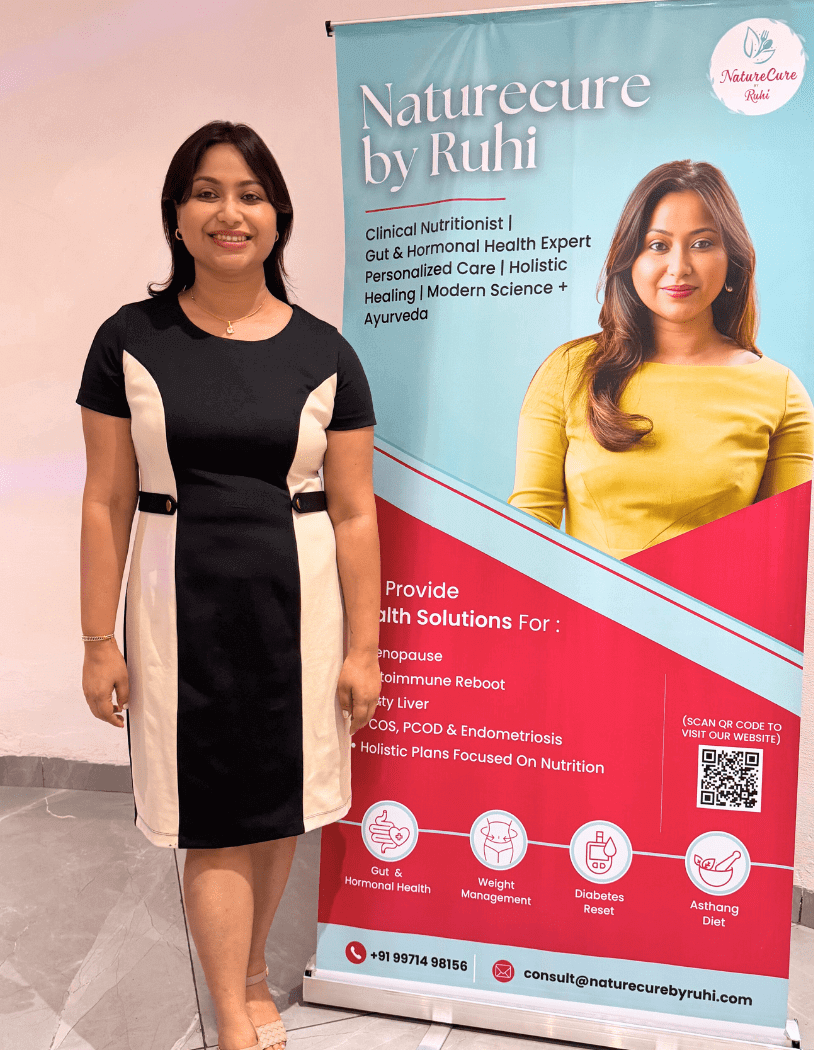





Beyond one-on-one consultations, Ruhi runs sessions where sustainable eating and heart health happen in real conversation — because sustainable dietary change isn’t just prescribed, it’s practiced.
Most cholesterol diet consultants in Gurgaon offer one generic “heart-healthy” diet regardless of what your actual lipid panel shows. As a cholesterol management dietitian working from both clinical and Ayurvedic principles, Ruhi’s approach treats LDL, HDL, and triglycerides as the distinct problems they are, building a plan around your specific numbers rather than a one-size-fits-all list of foods to avoid. This program is also designed to work alongside your doctor’s monitoring and any prescribed medication, like statins — never as a replacement for it. Cholesterol issues frequently overlap with fatty liver and insulin resistance, and this nutritional approach is built to address these together where relevant.

“What happened to my body?” is the question that comes up most often — not just a list of foods served. Ruhi’s work walks the real, root-cause answers to why the plan makes sense, not just what the plan asks of you.
Yes — reducing trans fats and processed foods, while increasing fibre and healthy fats, can meaningfully lower LDL for most people. The extent varies by individual and often works best alongside your doctor’s monitoring, especially if you’re already on medication.
Yes — triglycerides are a distinct marker from LDL cholesterol, and they respond much more to sugar, refined carbs, and alcohol than to dietary fat. A plan built for high triglycerides often looks quite different from one built for high LDL.
No — never stop or adjust cholesterol medication without your doctor’s guidance. This program is designed to work alongside your treatment, supporting your numbers through diet as well.
Many people see measurable improvement in triglycerides within 4–6 weeks of consistent dietary change, since they respond relatively quickly to diet. LDL improvements often take a bit longer, typically 2–3 months.
Yes — in that case, the plan focuses much more on reducing sugar, refined carbs, and alcohol, rather than the fat-focused approach that’s more relevant for elevated LDL.
This is a common scenario, and it needs its own approach — focused on physical activity, healthy fats, and lifestyle factors that specifically raise HDL, rather than the reduction-focused strategies used for high LDL or triglycerides.
Often, yes — especially for triglycerides and HDL. This program can work alongside a weight management plan if that’s relevant to your situation.
Yes. The assessment, plan, and follow-up structure are the same whether you consult your dietitian online or visit the Gurgaon clinic in person.
The terms are largely used interchangeably for this kind of care. Ruhi is a qualified dietitian with additional training in Ayurveda, giving you both clinically precise, lab-report-based guidance and a more holistic metabolic approach.
Online and in-clinic consultations available in Sector 54, Golf Course Road, Gurugram.
Book a consultation